Wednesday, April 22, 2015

Life Integrated Technology 5: Cyborgs - Deus ExMachina


If you’re a fan of the Terminator series or have watched Robocop, you have at some point wondered what it would be like to be part machine. It seems wondrous to ponder about all the marvellous things you could do with such a system.

You’d never need to carry a calculator to college. You could Google on the go. You’d never tire and do you even lift bro?
When most people think assisted living facility, their minds go to an old age home where people past their prime go to live out the end of their days.But what if you could have such a system inside you, taking care of your needs.
For some, this has now become a reality.

Take Nigel Ackland for example:
After losing his arm in a tragic work accident, he was fortunate enough to become the recipient of a bebionic3 arm. It connects to the muscles in his arm and with the help of microprocessors, the arm can perform virtually any hand position a person would need, even going so far as hand movements most people couldn’t even imagine. This allows him to pick up objects, shake hands, use his credit card, sign his name, change channels on a remote and even type. This all apart from his now machine precision grip and superhuman lifting abilities. The bionic arm even has a provision to sense when something is slipping from his arm and to correspondingly grip it tighter.


But you don’t need to lose a limb to become a cyborg. People have now begun to use Cybernetics to enhance their everyday lives.

Dr. Kevin Warwikis a Professor at Reading University, England and the founder of Project Cyborg.
Project Cyborg worked in two stages, the first gave Dr.Warwik the ability to control electrical appliances like doors and electrical fitting around him with Jedi like movements via a RFID chip implanted in his hand.

He famously demonstrated himself walking around his empty university building with the fans and lights turning on around him depending on where he was and doors opening for him as if by magic.
Having successfully completed his goals of stage one, he and his colleagues at the University created a neural interface between himself and a computer. This allowed him to control a robotic arm to mimic his movements.He then used the internet to remotely connect to an arm in the United States mounted with sensors allowing him an extra-sensory feel of a baseball cap. An extension to the experiment allowed him and his wife, who was also fitted with a similar device, the first direct and purely electronic communication between two humans.


This experiment opens up the possibility of a human being able to connect to the Internet.
With its vast resources, you’d have the entire world’s information at your disposal. The challenge comes as to how does one filter out the searches to exactly what you need and receive only the items with the most relevance. From there, it’s up to the human to make the most appropriate decision based on the information presented to them.

Machine learning has long been thought of as a way to make robots as or even more intelligent than humans, but we could use the same technology to give us the same capabilities of a machine.
The world of Bionics opens up an exciting prospect for the future. Who knows one day you could end up asking a friend, “Why is your arm stuck like that?”, only to have him reply, “Some malfunction, I need to update my drivers.”

Nestor Lobo

Life Integrated Technology 6: BITCOINS - The Currency Of The Future


“Bitcoin is a remarkable cryptographic achievement and the ability to create something that is not duplicable in the digital world has enormous value”
                          
                                                             Eric Schmidt
                                                  
On November 1, 2008, a man named Satoshi Nakamoto posted a research paper to an obscure cryptography journal describing his design for a new digital currency that he called bitcoin. Google searches for his name turned up no relevant information; it was clearly a pseudonym. But while Nakamoto himself may have been a puzzle, his creation cracked a problem that had stumped cryptographers for decades. The idea of digital money—convenient and untraceable, liberated from the oversight of governments and banks—had been a hot topic since the birth of the Internet.

Bitcoin is best thought of as a natural next step in the evolution of money. Throughout history, many items have been used as a store of value and medium of exchange, such as cowrie shells, clay tablets, coins, and now paper money.


As the global economy became more complex in the second half of the 20th century, most nations eventually moved away from the gold standard, creating fiat currencies built on laws and trust in government.As our understanding of money as a store of value, medium of exchange, and unit of account has matured, so have the methods and modes for exchanging it. In this sense, the exchange of money has always been a function of the technology available. We moved from precious metal coins to paper money before inventing checks, then credit cards. Yet credit cards weren’t created for the Internet era. They've simply been adapted to meet the needs of consumers operating in a networked and digital world. With the consumer-accessible Internet now 20 years old, the question is not why a currency specifically designed for the Internet has emerged, but what took it so long.

How does Bitcoin work?
Bitcoin is a protocol for exchanging value over the Internet without an intermediary. It’s based on a public ledger system, known as the block chain, that uses cryptography to validate transactions. Bitcoin users gain access to their balance through a password known as a private key. Transactions are validated by a network of users called miners, who donate their computer power in exchange for the chance to gain additional bitcoins. There is a fixed supply of 21 million bitcoins that will be gradually released over time at a publicly known rate. There is no monetary authority that creates bitcoins. The capped supply of 21 million is known to all, and the rate of supply diminishes over time in a predictable way. As a store of value, this means that bitcoins are inherently deflationary. It also means that there is no government or central entity to make discretionary decisions about how much currency to create or attempt to defend it through monetary policy actions.


In order to process a bitcoin-denominated transaction, Bitcoin verifies two facts addressed by current payment systems like PayPal or Visa. The first is that when user A transfers a bitcoin to user B, user A has a bitcoin to spend (that is, prevention of counterfeiting). The second is that when user A transfers a bitcoin to user B, user A is not trying to transfer the same bitcoin to another user, user C, simultaneously (that is, prevention of double spending).

As Bitcoin matures, an ecosystem of companies is emerging to support consumers and retailers in storing, exchanging, and accepting bitcoins for goods and services:

·       Banks and wallets store bitcoins for users either online or on storage devices not connected to the Internet, known as “cold storage.”
·    Exchanges provide access to the Bitcoin protocol by exchanging traditional currencies for bitcoins and vice versa.
·        Payment processers support merchants in accepting bitcoins for goods and services.
·   Financial service providers support Bitcoin through insurance or Bitcoin-inspired financial instruments. 

What are the qualities of Bitcoin as a technology system?
Bitcoin has three qualities that differentiate it from other currencies and payment systems.

·   First, Bitcoin is peer to peer, transferring value directly over the Internet through a decentralized network without an intermediary. Current payment systems, like credit cards and PayPal, require an intermediary to validate transactions; Bitcoin does not. As a result, Bitcoin has been referred to as “Internet cash,” as it can be exchanged from person to person much like paper currency today.
·     Second, Bitcoin is open, yet securely authenticated. Traditional payment systems rely on the privacy of transaction information to maintain security. For example, the compromise of a credit card transaction can result in the release of valuable information that can be used to conduct future transactions. In comparison, Bitcoin relies on cryptography. As every transaction is validated with cryptography by the network of miners, Bitcoin functions because of its openness, not despite it.
·        Third, Bitcoin is self-propelling. Bitcoin uses its own product, bitcoins, to reward or “pay” miners who are providing the computing power that serves as the engine of the transaction verification system. As a result, the system does not require the same type of overhead that traditional payment systems might require. In this sense, Bitcoin functions because of those participating in the system.

These three aspects are part of what drives Bitcoin’s success, enabling a nearly frictionless global payment system. However, these same factors have also created challenges.Today much of the thinking about the bitcoins and it's applications to institutional finance remains grandiose and undetailed; perhaps understandably given the technology and it's early stage of development. Much of it presupposes that bitcoin-based applications will be simple and trustworthy enough for investors to use with confidence.Bitcoin was constructed to behave like a currency: it’s very easy to use bitcoins to pay for goods and services, especially if what you’re buying is in a different country.But it’s very hard to be a currency when you’re also a commodity, governed by rules of scarcity and subject to speculative attack. Given the choice between something old and solid, on the one hand, and something new and virtual, on the other, the market is still voting for the asset class which has proved its worth over millennia.

Sree Lakshmi Addepalli


Tuesday, April 21, 2015

The Eureka Moment - 1

                                                                                            
Eureka! Right from Archimedes into his bathtub to finally comprehending that math conundrum at school, to finally working out what you want to do with your life; Life is full of those tiny candid Eureka moments which most of the times skip deserving acknowledgement and appraisal.
One of the first 'eureka' moments I had was when I could console a small crying and sobbing baby at my aunt’s place. Truly, I realised that day that consoling someone can be so difficult especially for those cuddling lads. Yes, it struck me ironically that making someone weep or depressing them by our harsh words and/or actions could be so simple but on the other hand bringing a smile on a weeping face could really be a mammoth task. From that point, I decided, whatever be my ambitions or career perspectives, my dream in life is to make everyone happy and content as far as possible. So, here I am today, spreading joy and laughter in all needed situations to the best of my capabilities.


http://uniwink.com/uniblog/wp-content/uploads/2015/02/eureka_1_.gif


Rightly said by Albert Einstein,”The true sign of intelligence is not knowledge but imagination.”

Yes, imagination blended with right knowledge is the essence of a Eureka moment!
We have all experienced that Eureka moment at some time or the other. To each and every one of us, it was a profound moment that might have changed our day or even our lives, but affected us as individuals and probably those around us too.

Well, my true Eureka moment knocked my doorstep a few years back when I was in the first year of my medicine studies pursuing MBBS. Yes, being an able doctor is possibly the noblest profession on earth by all leaps and bounds. But, unfortunately, it is not everyone’s cup of tea. It was when I realised that the path my career was going to head down was not the one I wanted and I wrestled with the decision to break out on my own. My true inner interests, passion and strength lied there when I could repair broken electrical equipment at my house, when using a screw driver perfectly was perhaps my biggest feat, when researching on various new softwares and technologies became my forte and programming became the very crux of my true existence. That 'Eureka' moment was came in walking on a beach at sunset when everything became clear and I knew then, that the path I was about to take was the right one. Eureka! 

Breaking all conventional odds, I dropped out of this could-be great catastrophic career of mine to follow my dreams and conquer my passion! It was Herculean but this is what gives me the right happiness, satiety and contentment. I am a budding engineer today currently in my second year and am making the most of my life in symphony. A harmonic and rhythmic life helps me spread my cheering joy all around and for everyone! Yes, it is truly bringing me to come closer to my mission in life- of spreading happiness all around- and I am subdued to the best of everything. Yes, life isn’t easy here, my decision as a great challenge but with no regrets at all for today I am following my dreams. In this topsy-turvy world, I know that I am bound to survive because I am completely responsible for all the wrath and boons to come over upon me!   


http://uniwink.com/uniblog/beautiful-eureka-moment/

Those path changing crossroads were an incredible source of my Eureka moments! I do completely believe that we all are here to serve a unique purpose in life. The only question is to identify and recognize that just in time. I desire today to be an excellent engineer and be a major contributor to the society and humanity as a whole. Yes, I have sensitized with and discovered my Eureka moment and I know I would be ushered in with all the required support on firming this decision of mine! And if not, no worries, because even the skies are not the limit when it comes to the enthralling race of chasing and conquering ones’ dreams! So keep the faith and keep going. :)


http://uniwink.com/uniblog/beautiful-eureka-moment/

Knowledge is Power ...
To get power, you need to learn.
The more you learn the more power you gain.
That's what we call the circle of "Eureka!"

Help your Eureka moments build on an iterative and a rational change in society for mass development. We are all one and there is just one earth.
So, let us bind on our Eureka moments to dignify humanity and peace thereby conquering on all vices and evils- social, political, national, economical, global, cultural or environmental- and have a tryst with that principle of oneness and equality.

Life is beautiful and is precious gift from God. So, let us acknowledge that and channelize our moments of accomplishment to wellness of all beings clearly to see those tiny Eureka moments of ours in the making.

As Socrates rightly puts in, “The Secret of Change is to focus all of your energy, not on fighting the old, but on building the new.”

Finally, I would draw a close by contemplating on these lines which made me sail through those roaring waters throughout-

“You have BRAINS in your HEAD
And FEET in your SHOES
You can steer YOURSELF in any
DIRECTION you CHOOSE! “
                                                                                                                                                           
Pawan Gidwani


The Eureka Moment - 2

The safety pin was invented while Walter Hunt was twisting a piece of wire, trying to think of something that would help him pay off a fifteen dollar debt. He later sold his patent rights to the safety pin for four hundred dollars to the man that he owed the money to.

The Barbie doll was born when Ruth Handler, a founder of Mattel, was on vacation in Switzerland and saw an unusual doll in the window of a cigarette shop. Because Handler didn't speak German, she didn't realize that the doll was a sex symbol sold mainly to men. Instead she saw a prototype for a new toy for girls.

Eureka moments feel like flashes of insight. Long walks or hot showers or fiddling with a pen may be where we think a life changing idea would strike us. Many of the innovative, creative people had accidentally come up with the inventions, below the threshold of the conscious mind that we now admire as the work of a genius.
In today's modern world, we still love to hear stories of sudden inspiration. The same guy, who invented the safety pin, later invented the sewing machine. Who had thought that sewing can be done with the hole on the wrong end of the needle? But he did. And it was a Eureka moment for him.

My Eureka moment came - when I found myself.

When we are young, we are generally not ourselves. What we eat, what we do, how we dress, where we go etc. is usually decided by our elders, something we call, an acquired personality. But as we grow up, we start realizing that we never actually did anything by choice. We were just living off others' expectations. That's when the journey to find ourselves starts. We start wearing what we like, eating what we please, stating our opinions and choosing our own friends.

I used to be the kind of kid every parent dreams of. Always hanging out with other smart kids, topping my exams and competitions, joining dance class, swimming class, music class, badminton coaching and what not, eating only the greens, always touching feet while greeting the elders etc. That time, it felt great to be always appreciated, to be the topic of discussion among ladies, to be the TAMED ANIMAL that I was. I am not saying that it was a bad thing. It was just not MY thing. I realized that I was just a person that others wanted me to be. And I was happy too. Because I was meeting their expectations just fine.

But time demands change. And it became more demanding when nerds like me went 'out of fashion'. Gullible as I was, being a teenager, the hormones turned my life around. I invested all my time in singing, being creative, solving crosswords, reading books(not related to syllabus), listening to music, partying, shopping, feeding on fame, and the best part is, people liked me even then, because they thought how 'cool' I was.
But then my grades started falling, I was lying more that often, I had become so thin that I could reuse my discarded clothes and I wondered where did I go wrong? Extra-curricular activities and less responsibilities are so addicting that we many a times lose track of time and importance of seriousness in life. I had become so easy going and not giving a damn about anything that the bubble of mediocricity had begun to close in on me. I couldn't figure what kind of person I had become. I was irritated all the time, being judgemental and angry on people. It's like backfire. It should not be this way. I had to get back on the right track. Then it struck me. Eureka. I said to myself, "Tanaya, maybe it's time you rediscovered yourself."

The first step was to say NO. I would not do something just because people will like it if I did. I'll be more of myself, than someone others want. I wanted friends that love me because of who I am, and not how I look or how famous I am. That's the key to happiness. After all, happiness is what we are all chasing in our lives. It's about being you. Knowing how to balance fun and work, and not over doing any. And when you think that something is not right and the limits are being crossed, take a break. You already know what's wrong. You just have to realize it. Maybe when you get back to your routine, after that short period of enlightenment, you might just find yourself shouting “Eureka.”

Tanaya Seth


The Eureka Moment - 3

“Eureka! Eureka! I got it!”We have all heard this expression for the very first time in relation to Archimedes and his bathtub experiment. Well it wasn't an experiment per say, Archimedes had just gone for a bath and the solution to a problem which had been revolving in his mind had struck him, and he had been so overjoyed (justifiably so) at finally making sense of it that he had run out of his bathroom and into the streets naked! Such is the euphoria of the ‘Eureka’ moment!

 Since then there has been a lot of speculation about the ‘Eureka’ moment.The ‘Eureka’ moment or ‘aha’ moment as it is also known is said to be a product of insight and ideas blending perfectly to give you the outcome that you have sought unknowingly for a long time.Two important things about the ‘aha’ moment are ;the Eureka moment is instant and it always elicits a positive effect i.e. the person experiencing it is convinced of its truth. The Eureka moment happens only when you are at an impasse. When you have tried all possible ways to solve a problem and you are stuck, that’s when the moment strikes!

As Carl Honore says ,“Your best ideas, those eureka moments that turn the world upside down, seldom come when you’re juggling emails, rushing to meet the 5 pm deadline or straining to make your voice heard in a high stress meeting. They come when you’re walking the dog, soaking in the bath or swinging in a hammock”. Yes, the Eureka moment hits when your mind isn’t focused on the problem, what psychologists call as the period of incubation. So some people purposefully keep aside time for relaxation or juggle their tasks, so that though their conscious mind is focused on one task, the others are incubating in their subconscious. It has also been found that many eureka moments have been triggered in a dream. It is believed that the structure of benzene came to Kekulé in a dream. 

Dreams are nothing but our unconscious thought processes. When a lot of information on a particular topic is present in your brain, when you sleep your subconscious tries to link them and make sense out of it. What does this indicate? That Eureka moments don’t just happen out of magic. For that the person needs to have prior knowledge and relevant information of his subject. It is a condition as if the solution is dancing on the recesses of your mind but you still can’t reach it, which brings us to our next point: Think outside the box. Many a times our brain follows the same line of thought ‘n’ number of times and to find a way out you have to try a different approach, a distinct outlook and voila! We get the key to our riddles. This is also the reason why it is advised to take a break, so that during this period the previous thought ways are erased and we can handle. According to the Alternate Uses test by Sophie Ellwood, it has been proved that when stuck on one job, if you take a break concerning other work; the chances that you will return with a 'eureka' are high.

Having said and done all that there is to this, it is still not possible to device a formula for the eureka moment. As Roger Penrose puts it in a very simple yet complex way, 

"Eureka moments
tend to be little things, a little
realisation and then a little

realisation built on that."

Manisha Patro

The Eureka Moment - 4

As a child of a divorce, Sarang never truly felt loved. In spite of both his parents' efforts, little insecurities did always creep in. There were times when he had severe panic attacks. He even saw a shrink. Of course, that didn't really help much, but it was the best his parents could do. For the human mind is a very complex structure. Sometimes it can face mountain-loads of adversaries, whereas on the others, it takes the smallest of things to trigger it's downfall. Truly, the wounds of the mind are the hardest to heal.
Thus he grew up having quite a quiet childhood, with monthly appointments with the psychiatrist. All the while, on a quest to find 'love'.

His mother, Lata, was a sweet lady who worked as a nurse in a well-off private hospital. She was the one with Sarang's custody. She always told him that 'love' is when you care more about the other, than you did about yourself. This was almost always immediately followed by a "but your father cares about nothing but his own life". Thus, to Sarang, 'love' became a very difficult thing to have, as his father couldn't possess it, and if he couldn't, then who can? After all, "my daddy strongest", right?
Lata's ex-husband, Sarang's father, Mr. Gopen Patel was a hot commodity in Gujarat. His life could've been right out of a Bollywood movie, with the typical from "rags to riches" stuff. But not to let that undermine his hard work and achievements, as it is nowhere as easy in real life as it appears on the reel front.Unlike most around him, he didn’t have a Saree or jewelry business, his was an empire of transformers. He was a no nonsense man who didn’t really have the time for Sarang’s questions on love. “Love is a tool fools use to kid themselves”, is the best he could ever get out of him.

Sarang was used to watching his parents bicker over the slightests of things from a very young age. Sometimes he pretended that it wasn’t happening by indulging himself in television or the movies, the rest he tried to calm down his parents. But after each quarrel, each bigger and over a sillier reason than the previous, the three would always sit together peacefully watching the movies at home, eating popcorn from one huge bowl, tucked in under one big sheet. This was truly a cherished memory for him. He believed that had he been in JK Rowling’s wizarding world and been asked to conjure a patronus, this memory of his would’ve produced the strongest patronus in the world. It was that strong, happy and special a memory to him. But then, one fine day his parents dropped the missile on him- the news that they had decided to get separated. Poor little Sarang was just 12. He tried all he could, but who could change the mind of two determined adults? Children are much wiser in this aspect as adults, to their own folly, often make the worsts of decisions out of a misplaced case of ego. But then again, sometimes it’s better to just let go.

His schooling life was quiet and quite uneventful. He hardly opened up to anyone. He had massive trust issues. He saw all his friends’ parents, both of them coming to their Parent’s Days or to the Parent Teacher Conferences. This always made him sad. He saw all the kids around him being happy, jovial, indulging in relationships, etc. He for one could never get into one, as he was too paranoid that eventually everyone he liked would leave him. He saw many such cases of breakups of his batch mates as well, which further turned him against the prospect.

All this continued until once, at the age of 19, he was returning home from college, and he met with a serious car accident. His chauffeur collided his car against a truck. He was gravely injured and taken to the hospital immediately. Luckily he survived, although he wasn’t too thankful of that. But something happened which changed everything for him.
He was in the hospital for 7 days, and during this time, both his parents were at the hospital throughout. They spent whole days together in the hospital, by his side, not fighting even once. They were completely into their son’s welfare, they forgot all about their mutual differences. They left their work, their ego, their past and everything behind! They talked to him, fed him, made him laugh, saw to his injuries, made sure he took the right meds at the right time. All in all, they were a perfect little happy family. In that moment, he did truly feel ‘infinite’.

For once, he felt loved. He felt special. He forgot all the bitterness that he had developed inside of him. He forgot all the sad memories, and was just brought back to those happy memories with the popcorn, the sheet and the movies. What was an enigma to him suddenly became an answer to everything. It was kind of an epiphany where his quest finally seemed fulfilled.

He realized that maybe both his parents were right in their definitions of love. Yes, he truly saw his parents’ love. They overlooked their own personal issues for the sake of their son. It is indeed about caring more about someone else than oneself. Also, love is an abstract thing, doesn’t truly exist to the outside world. It is merely something fools use to make themselves feel better. But in that regard, all of us are fools! We all yearn for love, and we accept the love we think we deserve. Sarang thought throughout that he didn’t deserve any. Thus unknowingly, he blocked himself from all the love he could’ve possibly received. True love doesn’t need any form. It is just out there for you to grasp. Sometimes stuff doesn’t work out the way you want it to, but that doesn’t undermine the love that was there, the love that is there and this love which will always remain.

Just like every other son, daughter, mother, father, friend, girlfriend, boyfriend, spouse or whatever. We are all entitled to love and to be loved. We all spend our lives in search of the much hyped- ‘true love’. Only we fail to see it. But eventually, even if it be for a very short while, we do have our “eureka moments”, where we finally find it. Only we must remember to grasp on to it with both hands, and cling to it forever. Just like little Sarang Patel. J

Samarth Ladia

The Eureka Moment - 5

The Aha!! Effect …..

Let’s start this a bit technically, so what’s a proper definition of the term “Eureka Moment”. Wikipedia defines it has … “Eureka" is an interjection used to celebrate a discovery or invention. That seems to be a very difficult one to get known to what actually Eureka moment mean. In simple words, it’s a flash of a moment when one feels that “I have found it…”

History states that, this word of first attributed to the famous ancient Greek scholar Archimedes. He reportedly proclaimed "Eureka!" when he stepped into a bath and noticed that the water level rose—he suddenly understood that the volume of water displaced must be equal to the volume of the part of his body he had submerged. Yeah that was the moment J quite funny!!
It’s actually a good word; everyone should use this word from time to time, to make you exciting while spilling it out!

Imagine sitting in an exam hall, seeing at the question paper and wondering what the solution is and in a flash you get a solution!!!!Feels so good, that’s an awesome Eureka Moment, for sure.
Know Isaac Newton? Yes the man who discovered Gravity. Actually, if you go through that incident again you’ll see it’s a heck of a Eureka!!! Let’s rewind this a bit.

Isaac Newton was a shy, quiet boy growing up on a farm in England 300 years ago. He was not a very good student and nobody cared about him. He was a guy who always kept on asking “Why? This, Why that?  & so on…. Until One day he was lazy sitting in a garden wondering how things will go … and then … An apple fell out of the tree - bonk! Ow!

Now for most people that would be the end of the story, but not for Isaac. Not for somebody who just couldn't stop asking why all the time. Why did the apple fall out of the tree? Does everything fall? What makes things fall? Can anything stop things from falling? Are the sun, moon, and stars falling? Why don't they ever hit the ground? and then he came up with the theory of Gravity!!!
It is one of the most famous anecdotes in the history of science but for us it’s just a brilliant example of Eureka Moment.

Eureka Moments have also been referred as Eureka Myth. Like, as we winded up that apple fall on Isaac’s head & he came up with theory of Gravity, seems a Eureka moment, but actually it’s a Eureka Myth because Isaac spent many years after it to actually come up with the concept of Gravity.
Although it is commonly thought that Charles Darwin came up with his theory of natural selection while on the Galapagos Islands in 1835, he only started to believe in evolution after he returned to England. Instead of being struck by a single "Eureka moment", the scientist spent two decades pondering his observations, finally presenting his controversial theory in his 1859 book On the Origin of Species. Sofia Mitra-Thakur

Popular culture has its own views of the Aha! Effect. Although both are defined as that moment of insight that changes one's state of mind, its applications greatly differ. Where scientists have focused on understanding the mechanisms of insights as well as how and where Aha! Moments occur in the brain; Oprah Winfrey has taken this phenomenon and turned it into a popular and well-recognized state of mind. By focusing on the emotional and life changing occurrences an individual experiences, Oprah views the Aha! Effect as a sudden moment of realization, where an individual recognizes that they need to make a change or move forward in life. Oprah includes Aha! Moments in her monthly magazine, O: the Oprah Magazine, and commonly makes reference to these moments of insight on her television show, Oprah

Eureka moments feel like flashes of insight because they often come out a period when the mind isn’t focused on the problem, what psychologists call a period of incubation. Incubation is the stage where people briefly step back from their work. Many of the most productive creative people intentionally set a project aside and take a physical break from their work believing that this incubation stage is where ideas begin to come together below the threshold of the conscious mind. Some people juggle various projects at the same time under the belief that while their conscious mind is focusing on one project, the others are incubating in their unconscious. The insights that come after incubation are what feel like we’re tapping into the same idea-generating force that powered Newton and Archimedes.

After going through all the above stuff, what comes up that, Eureka Moments can be any simple things happening with you at any instant of time. The thing is that in this busy modern life no one has time to actually realize that which moment was Eureka.

Here are a few tips to get inspired to strike and find your Eureka moment.
Slow down
Slowing down to find whitespace in today’s fast paced, non-stop, all consuming world is easier said than done. That’s especially true now that mobile phones have found their way into every corner of the globe. Getting away, out of your normal routine and disconnected from the daily grind doesn’t just happen anymore; you’ve got to be purposeful about it. You've got to seek out quiet spaces.
Get outside the bubble
If you think about it, we live the bulk of our lives in a bubble, moving temporarily from one to the next. Each bubble personalized for our comfort and familiarity, by design. Home, car, office, car, home, repeat. By design, there’s nothing particularly stimulating about them, even if we build them to foster "creativity," they’re still stagnant, and as such, will only temporarily stimulate a new perspective.
Extend today’s observations into the future
This last step is perhaps where the magic happens, but note that the degree to which you succeed here is largely predicated upon your ability to 1. Slow down (create whitespace) and 2. View problems from a new perspective.The trick is to take a simple observation or trend and mentally extend it out in some fashion into the future.

I grew up thinking Eureka moments were, as if by divine intervention, supposed to simply appear.
I learned however that nothing could be farther from the truth, at least in my case. What some call "vision" is actually nothing more than taking the time to connect the dots? In fact, it’s entirely possible to manufacture eureka moments by creating the right circumstances, and by simply being open and thoughtful about what I was already observing every day.
So, let’s conclude this article.
Isaac discovered gravity, Archimedes discovered law of hydrostatics, Charles Darwin discovered theory of evaluation all these were initiated by a Eureka Moment.
And even your solution to a tough problem in “Math!!!” too was a Eureka Moment J
The point is that, some moments happen in flash and you just don’t get to know whether it’s a Eureka Moment or not. What you need is to follow the 3 tips given above, create & realize your Eureka Moments!!!!  So I’d like to wrap this out saying …


~~Eureka Moments Don't Just Happen, But They Can Be Created~~                                                          
                                                                                  
Prasad Pawaskar

The Eureka Moment - 6


Archimedes Coined the Term "Eureka!" in the Bath. During a subsequent trip to the public baths, he realized that the more his body sinks into the water, the more water is displaced--making the displaced water an exact measure of his volume. Because gold weighs more than silver, he reasons that a crown mixed with silver would have to be bulkier to reach the same weight as one composed only of gold; therefore it would displace more water than its pure gold counterpart. Realizing he has hit upon a solution, the young Greek Math whiz leaps out of the bath and rushes home naked crying "Eureka! Eureka!" Or, translated: "I've found it! I've found it!"
In layman terms, Eureka is an exclamation of triumph on discovering or solving something. What I feel is, Eureka moment is that moment which gives you happiness, a sense of joy, a sense of satisfaction.

You’re just flesh. Your soul animates you and the ones that surround you. As an optimist it is my responsibility to not have a boring life. To feel deeply. To listen to the stories of strangers. To try new things and go new places. To say yes. To question everything. To find beauty in the commonplace. And to fall in love. Over and over. Living almost an ordinary 19 years of my life, I fail to recognize the extraordinary (Eureka) moments. However, I did find happiness, a sense of joy& achievement in my everyday small moments (Not to mention, I would run around naked for such events).

Napoleon Hill has rightly said: “If you can't do great things, do small things in a great way.” Creativity and insight almost always involve an experience of acute pattern recognition: the Eureka moment in which we perceive the interconnection between disparate concepts or ideas to reveal something new. “I could see why Archimedes got all excited. There was nothing finer than the feeling that came rushing through you when it clicked and you suddenly understood something that had puzzled you. It made you think it just might be possible to get a handle on this old world after all.” Completing a piano piece, discovering your own dance steps, solving a Sudoku puzzle, that sense of feeling when you reach the 32 mark in your paper, winning an ISTE event, completing a TV series and remembering all the dialogues while re-watching it, painting some abstract that turns out to be beautiful, finding out that resistor due to which your experiment failed again and again, completing a marathon, finding new moves in chess to defeat your dad although deep down you knew; he always wanted you to win, cracking your vivas in front of a nut-crack external, generating a smart witty reply when someone is upset with you! Achievement has no colour. However small it maybe, it is that exclamation of triumph that matters.

You get educated, you get degrees, you take a job or make one yourself, you earn, and you keep on earning money; for what? Happiness? Peace? Survival? Why don’t just earn a living instead of earning money? Why not find happiness in your small moments? Why struggle 24x7 for that one Eureka moment? Why do stuff you don’t want to do, for stuff you don’t need? Look wider, look at the bigger picture. I don’t have one single extraordinary Eureka moment that world will remember forever but I do hold thousands of small ordinary Eureka moment that are sufficient to make me happy in the long run. Grow some balls, take a risk, think different and live life the way you want to because ‘Nothing is Ordinary’.

- Dev Sanghvi

Tuesday, March 31, 2015

MIT APP INVENTOR


When one thinks of Android application development, the thoughts that struck the mind are installing JDK, SDKs and Eclipse and so on. We can hardly think of developing our own app (without any use of template) of course, without the knowledge of JAVA unless we come across the MIT App Inventor. Yes, developing Android applications without even knowing any bit of JAVA

App Inventor for Android or commonly known as the MIT App Inventor is an open-source web application originally provided by Google, and now under maintenance of Massachusetts Institute of Technology (MIT). It was released publicly on December 15, 2010 and the team was led by Hal Abelson and Mark Friedman.

At a point where the traditional way of developing the apps through Eclipse or the Android Studio more recently may seem to be a hardcore techno- geek's job, developing the app on MIT AI seems nothing but just a game. There is no code involved physically; we just need to keep on connecting blocks similar to jigsaw puzzle and you are done with your app.

Once after visiting the website, we need to just login through our Gmail email address and get started. No installations, no downloads! Technically the procedure can be divided into two sections viz., designer and blocks.
Designer is the empty space where you can drag and drop the requirements of your app such as buttons, text fields, etc and invisible components such as sensors, clock, etc. On the blocks
screen, there are various blocks of every component selected. Apply the logic of your app and connect the blocks same as just in the jigsaw puzzle.

Here is small example of app which on clicking the button changes its colour to red.
Firstly, the button was dragged from the left side of the screen on the canvas. Then by switching onto the blocks screen, the logic was implemented as represented in the figure below.


Fig. 1: Designer Screen


Fig. 2: Blocks screen


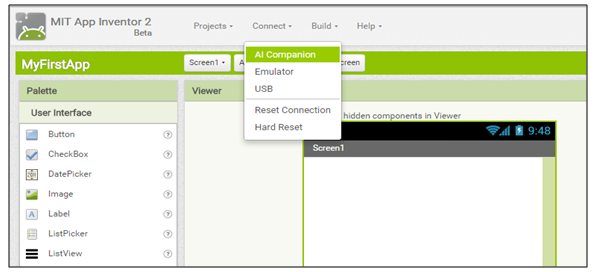
While developing Android applications, testing is required after making the app or at times while developing to see whether we are going on a right path.  AI simplifies this work too. There are three
methods available for testing: downloading AI Emulator, connecting your smart phone (details of which are readily available on the website) and the most interesting and unique is their MIT AI Companion app.
One can choose this option in connect menu.


Fig. 3: MIT AI2 Companion App

 It generates a QR code which is to be scanned through the companion app and the output of your code gets displayed on the screen of your smart phone.

Fig. 4: QR Code connection

The tutorials, videos, source files available on their website make the use of App Inventor even easier and simple. MIT keeps on integrating with different organizations to conduct workshops and competitions using MIT App Inventor even at the schooling level. Various App summits, Monthly Best App competition, etc makes the learning competitive.

The MIT App Inventor facilitates easy learning and interesting app development for everyone ranging from novice beginners to the experts too. So, build your own app using this simple technology. Happy App-Making! J

Jayesh Ahuja

Web of Things


“How do you distinguish a WoT thing from a mere IoT thing?
Try talking client-side JavaScript to it, if it just stares at you like you used some kind of an unknown language then this isn’t a WoT thing…”

The Internet of Things (IoT) is an extension to the current Internet that enables connections and communication among physical objects and devices (see the September 2013 Computing Now theme for more on IoT and its role in ubiquitous sensing). Estimates suggest that there will be 50 billion devices and people connected and leveraging the vision and technology behind IoT by 2020. A related term that's currently somewhat in vogue is Internet of Everything (IoE), which recognizes the key role of people, or citizen sensing (such as through online social media), to complement the physical sensing implied by IoT.
The term Web of Things (WoT) goes beyond the focus on the Internet as the mode of exchanging data, instead bringing in all resources and interactions involving devices, data, and people on the Web. Correspondingly, it brings into focus a wide variety of challenges and opportunities while paving a way to a variety of exciting applications for individuals to industries.
WoT: Supercharging IoT and IoE
Sensors and devices collect data with a wide variety of types (such as temperature, light, sound, and video) and that are inherently diverse (data quality and validity can vary with different devices through time; data is often location- and time-dependent, and so on). WoT resources can be ubiquitous and are often constrained in terms of power, memory, processing, access, availability, attention, and communication capabilities. The resources' heterogeneity, ubiquity, and dynamic nature, coupled with the wide range of data, make discovering, accessing, processing, integrating, and interpreting the data on the Web a challenging task.
A rich cyber component of WoT includes Web-resident data, knowledge (in Wikipedia or Linked Open Data, for example), information exchanged over social media (such as sites in which patients share health-related information), and user-submitted physical world observations and measurements. Integrating physical, cyber, and social resources enables the development of physical-cyber-social (PCS) applications and services that can incorporate situation- and context-awareness into the decision-making mechanisms, and can create smart data out of big data by harnessing volume, variety, velocity and veracity to create actionable information. Examples of such applications range from personalized health, fitness, and well-being to energy and an increasingly wide variety of business and industrial activities.
Anand Bhagwani